What is RWA? Understanding the Basic Concept of Real World Assets On-Chain
RWA (Real World Assets) has become one of the most important trends in the blockchain industry in recent years. It aims to bring real-world assets onto the blockchain, enabling these assets to be traded and financed on-chain. This lesson introduces the basic concept of RWA and the background behind its emergence.
I. What is RWA?
RWA, or Real World Assets, refers to real-world assets in Chinese. In the blockchain context, RWA means mapping real-world assets onto the blockchain through legal structures and blockchain technology, allowing them to be recorded, traded, or financed on-chain.
Simply put, the core idea of RWA is to bring real-world assets onto the blockchain.
Traditional blockchain networks initially mainly carried native crypto assets, such as BTC, ETH, or various DeFi Tokens. The emergence of RWA means that blockchain is no longer just a closed crypto financial system but is starting to connect with real-world asset structures.
The types of assets that can be included in the RWA system are very broad, for example:
- Government bonds (sovereign debt)
- Real estate assets
- Gold and other precious metals
- Corporate loans
- Accounts receivable
- Private equity fund shares
- Infrastructure revenue rights
Through tokenization technology, the rights and interests of these real-world assets can be represented as tokens on the blockchain, enabling their transfer, trading, or collateralization within the blockchain network.
From a broader perspective, RWA is essentially an attempt to upgrade financial infrastructure. It seeks to leverage the transparency and programmability of blockchain to reconstruct how traditional financial assets are issued, circulated, and settled.
Therefore, RWA is not just a technological innovation; it is also an important bridge between traditional finance and crypto finance.
II. Why did RWA emerge?
The emergence of RWA is not accidental but a natural extension as the blockchain industry has reached a certain stage of development. There are two main driving forces behind it.
1. Blockchain needs real-world assets
In the early stages of blockchain development, most DeFi (Decentralized Finance) activities were centered around crypto assets themselves, such as:
- ETH collateralized lending
- Crypto asset trading
- Liquidity mining
- Stablecoin minting
While these models fueled rapid DeFi growth, they essentially involved circulation among on-chain assets.
For example: users collateralize ETH → borrow stablecoins → participate in liquidity mining → earn new tokens. In this system, capital mainly flows among on-chain assets and lacks support from real-world economic cash flows.
This leads to a long-standing problem: DeFi yields often rely on new funds entering the system rather than coming from real economic activity.
The emergence of RWA aims to solve this problem. By introducing real-world assets such as:
- Sovereign bond interest
- Real estate rental income
- Corporate loan interest
The blockchain financial system can gain yield sources from real economic activity, making on-chain financial structures more stable and sustainable.
2. Limited liquidity in traditional financial assets
On the other hand, in the real world, many assets are highly valuable but have very limited liquidity.
For example:
- Real estate transactions typically take months or longer
- Private equity fund shares usually have lock-up periods
- Corporate loans or debt assets are often only transferable among institutions
These assets often have two main issues:
- High transaction thresholds. Many assets are available only to institutional investors or high-net-worth individuals.
- Low liquidity. Once acquired, these assets are difficult to liquidate quickly.
Blockchain technology provides a new solution. Through tokenization, assets can be split into smaller units and traded globally, significantly increasing liquidity. For instance, an asset worth $100 million can be divided into 1 million tokens, allowing ordinary investors to participate by purchasing just a few tokens.
This model is considered potentially transformative for traditional asset circulation.
III. What is Asset Tokenization?
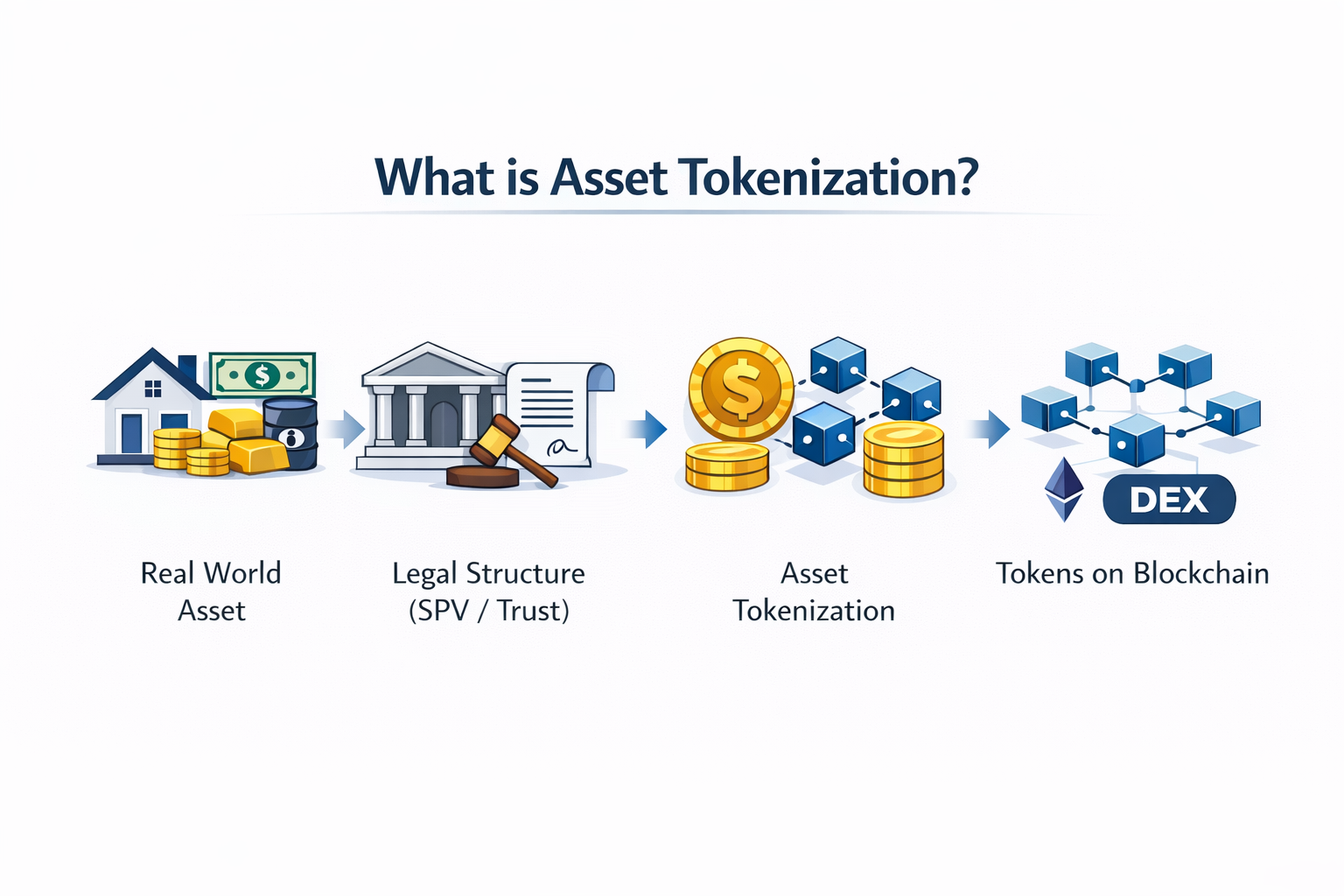
The core technological foundation of RWA is asset tokenization.
Asset tokenization refers to converting the rights and interests of real-world assets into digital tokens using blockchain technology.
These tokens can be transferred, traded, or used as collateral on the blockchain, thus making the asset more liquid.
A simple example:
Suppose a piece of real estate worth $10 million undergoes tokenization. This property can be split into 1 million tokens, each representing a small portion of ownership rights in the property, such as:
- Ownership share
- Rental income right
- Capital appreciation right
Investors only need to purchase a certain number of tokens to indirectly participate in real estate investment.
This brings two important changes:
- Assets can be fractionalized: Traditional financial assets often have high investment thresholds, while tokenization can break them down into smaller units, lowering barriers to entry.
- Assets can circulate on-chain: Tokens can be quickly transferred within the blockchain network, making asset trading more convenient.
For this reason, asset tokenization is considered an important technological bridge between traditional finance and blockchain.
IV. How does RWA differ from traditional financial assets?
Although the underlying assets of RWA originate from the real world, their operation differs significantly from traditional financial systems. In traditional financial markets, an asset typically goes through multiple intermediaries from issuance to trading, such as:
- Banks
- Brokerages
- Custodians
- Clearinghouses
- Settlement systems
These institutions form the backbone of traditional financial infrastructure but also lead to higher costs and slower settlement speeds.
One of RWA’s goals is to optimize this process using blockchain technology. For example:
- Greater transparency: Blockchain transactions are usually publicly verifiable, allowing investors to clearly track asset movements.
- Faster settlement: Traditional securities settlement often takes T+2 or T+3 days; blockchain can achieve near-instant settlement.
- More open market participation: Blockchain networks are globally accessible, allowing more investors to trade these assets.
However, it’s important to note that RWA differs from pure crypto assets. Because their underlying assets exist in the real world, RWAs still require:
- Legal structures
- Asset custody
- Audit mechanisms
In other words, RWA is essentially a model that combines on-chain technology with off-chain assets.
V. Why has RWA attracted attention recently?
In recent years, RWA has gradually become an important trend in the blockchain industry. Many large financial institutions and crypto projects have started exploring this field.
The main reasons include three aspects:
3. Institutions are entering the crypto market
As blockchain technology develops, more traditional financial institutions are paying attention to crypto asset markets. For these institutions, RWA provides a relatively familiar path. Compared with purely native crypto assets, RWAs are still based on traditional assets and thus are easier for institutional investors to accept.
Therefore, many institutions see RWAs as an important entry point into blockchain finance.
4. DeFi needs stable yield-generating assets
In DeFi systems, most yields come from transaction fees, token incentives, or market volatility. However, these returns tend to be highly uncertain.
In contrast, real-world assets such as government bonds or corporate loans can offer more stable sources of income.
For example:
- Government bond yields
- Corporate loan interest
- Asset leasing income
These stable cash flows provide a more reliable foundation for DeFi yields. As a result, more DeFi projects are exploring bringing real-world assets on-chain.
5. Blockchain infrastructure is maturing
In the early stages of blockchain development, both technology and regulatory environments were relatively immature. In recent years, however, with advancements in infrastructure such as:
- Smart contract platforms
- On-chain identity systems
- Compliant custody services
- Stablecoin systems
RWA projects now have more robust technical and compliance foundations. This has led more projects to try combining real-world assets with on-chain finance.
Conclusion
RWA (Real World Assets) refers to mapping real-world assets onto blockchain networks via tokenization technology so they can be traded, financed, or managed on-chain. This model seeks to build a bridge connecting traditional finance and crypto finance:
It introduces real economic assets and yield sources into blockchain finance while providing new liquidity channels and more efficient trading methods for traditional assets.
As blockchain technology and financial infrastructure continue to develop, RWAs are likely to play an increasingly important role in future financial systems.
Lesson 1:What is RWA? Understanding the Basic Concept of Real World Assets On-Chain
Lesson 2:How Does RWA Work? The Complete Process of Bringing Real-World Assets On-Chain
Lesson 3:The Core Structure of RWA: How Are Real-World Assets Tokenized?
Lesson 4:Main Types of RWA Assets: Which Real-World Assets Are Entering the Blockchain?
Lesson 5:Why Has RWA Suddenly Exploded? The Three Driving Forces
Related Courses
The Beginner's Guide to Blockchain-based Airdrops
Crypto Mining Equipment

Learn about web3 data and analytics

Identity in Crypto: Main Projects
Introduction to Masternode Tokens