How Does RWA Work? The Complete Process of Bringing Real-World Assets On-Chain
Real-world assets cannot be directly "moved onto the blockchain," so multiple steps such as legal structuring, asset custody, and token issuance are required. This lesson will introduce the basic workings of RWA and explain how real assets are transformed step by step into on-chain tokens.
I. Why Can’t Real-World Assets Go Directly On-Chain?
Before understanding how RWA works, it’s important to clarify a key point: Real-world assets cannot exist directly on the blockchain.
The blockchain is essentially a distributed ledger system that records digital information. It typically records:
- Digital assets
- Transaction records
- Smart contract states
- Token ownership
However, most real-world assets are not purely digital information; they are physical assets or legal rights, such as:
- Real estate
- Bonds
- Corporate loans
- Gold
- Accounts receivable
These assets usually exist within legal systems and asset registration frameworks in the real world, such as land registries, bank ledgers, or company balance sheets.
Therefore, the blockchain cannot “store” these assets themselves directly.
This means the core of RWA is not physically moving assets onto the blockchain, but mapping asset rights information onto the blockchain through technical and legal structures. What the blockchain records is not the asset itself, but its ownership or income rights.
For example, when a real estate asset is tokenized, the blockchain records how many tokens a particular address holds, and these tokens correspond to a portion of the real estate’s rights under a legal structure. This allows real assets to be digitally managed on-chain while still relying on real-world legal systems to confirm asset ownership.
II. The Basic Structure of RWA Operations
In practice, a complete RWA project typically relies not only on blockchain technology but involves multiple roles forming a financial structure.
A typical RWA project usually includes the following key participants:
1. Asset Originator
The asset originator is the provider of the real-world asset.
They may be:
- Real estate developers
- Financial institutions
- Corporate loan platforms
- Infrastructure operators
These entities provide assets that can be tokenized, such as real estate projects, debt assets, or fund shares.
In short, the asset originator is the source of the assets in the entire RWA structure.
2. Legal Structure (SPV Company)
To ensure the legality of asset rights, RWA projects typically establish an SPV (Special Purpose Vehicle) company.
An SPV is a legal entity set up specifically to hold an asset or manage an investment.
The main purposes of establishing an SPV include:
- Holding real-world assets
- Isolating risks
- Managing assets on behalf of investors
- Ensuring clear asset rights
In many RWA projects, when investors purchase tokens, they do not directly own an asset but instead indirectly hold the rights to assets represented by the SPV.
This structure is also common in traditional finance, such as in asset securitization products.
3. Custodian
Real-world assets need to be held or managed by third-party institutions.
Common custodians include:
- Banks
- Trust companies
- Professional custodians
- Financial service providers
The custodian’s responsibilities usually include:
- Safekeeping assets or related legal documents
- Verifying the existence of assets
- Overseeing asset management processes
- Conducting regular audits
The custody mechanism is a critical part of an RWA project because it directly affects investors’ trust in the authenticity of the assets.
4. Blockchain Platform
The blockchain platform is the technical infrastructure for RWA.
It is mainly responsible for:
- Issuing asset tokens
- Recording token holdings
- Executing smart contracts
- Handling transactions and income distribution
Through blockchain networks, tokens can be transferred and traded globally, increasing asset liquidity.
5. Investors
Investors are the capital providers in the RWA system.
By purchasing tokens, they can obtain:
- Asset income rights or
- Partial ownership of assets
Investors can choose to hold tokens long-term for returns or trade them in secondary markets.
III. The Five Key Steps for Bringing Real Assets On-Chain
After understanding the participants, let’s look at how a typical RWA project operates.
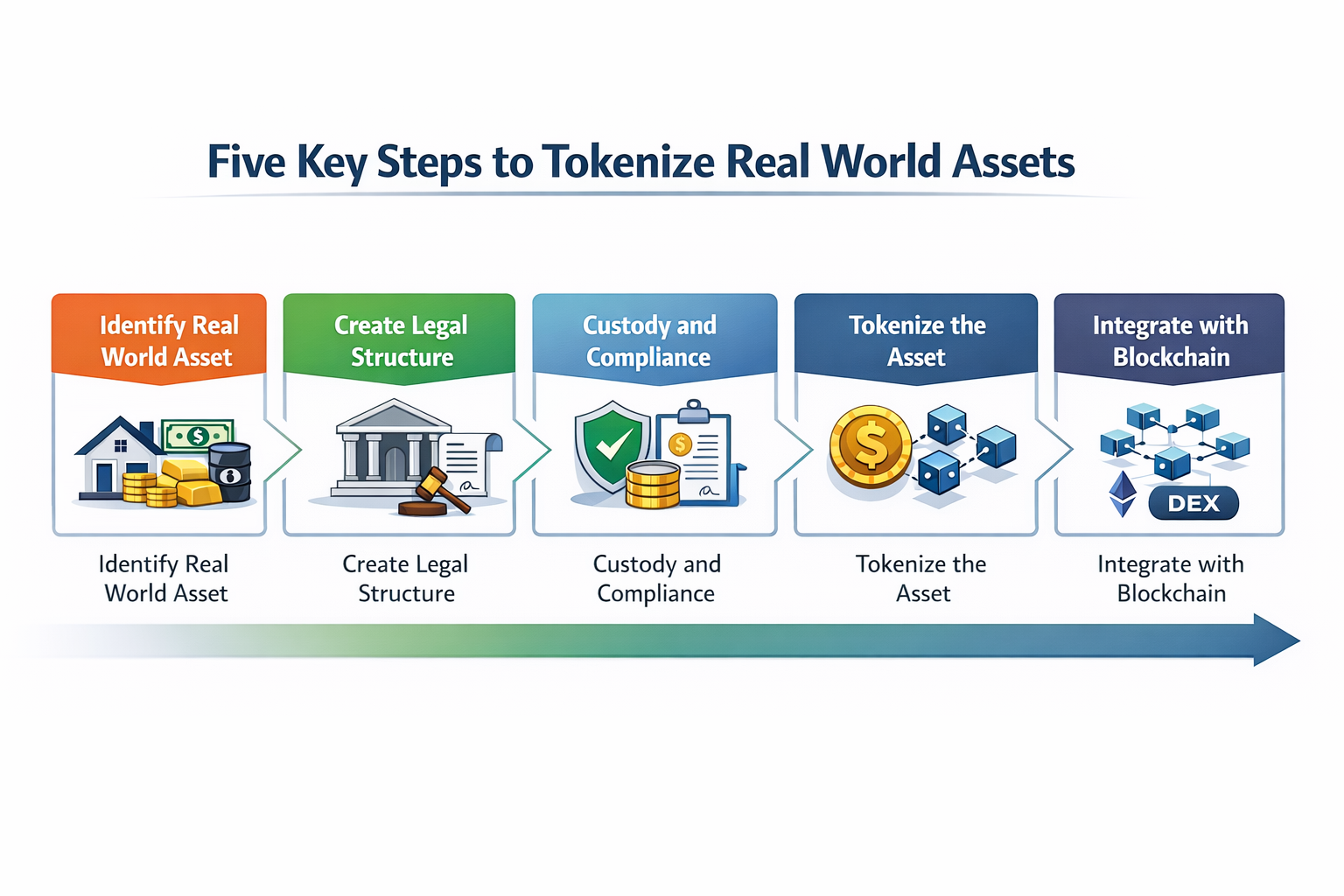
A complete RWA project generally goes through these five steps:
Step 1: Selecting Real Assets
The project team first needs to select suitable real-world assets for tokenization.
Common asset types include:
- Government bonds
- Real estate
- Corporate loans
- Accounts receivable
- Precious metals
- Infrastructure income rights
These assets usually have several characteristics in common:
- Relatively stable value
- Clear income structure
- Clear legal ownership
- Auditable
Assets meeting these criteria are more easily accepted by investors and better suited for tokenization.
Step 2: Establishing a Legal Structure
Once the asset is identified, the project team typically sets up a corresponding legal structure.
The most common approach is to establish an SPV company.
The main functions of an SPV include:
- Holding real-world assets
- Managing asset income
- Representing investor interests
- Providing legal isolation
Through this structure, when investors purchase tokens, they essentially hold the rights to assets represented by the SPV. This structure effectively reduces legal risks and ensures investor protection.
Step 3: Asset Custody
To ensure asset safety, real-world assets are typically held by independent third-party institutions.
Custodians are generally responsible for:
- Safekeeping assets or related documents
- Verifying asset authenticity
- Overseeing asset management
- Providing audit reports
For example, in tokenized gold projects, gold is usually stored in professional vaults with custodians regularly issuing reserve certificates.
The existence of a custody mechanism can greatly enhance the credibility of an RWA project.
Step 4: On-chain Token Issuance
After completing legal structuring and custody arrangements, the project team issues asset tokens via blockchain.
Each token usually represents a portion of ownership or income rights to an asset.
For example: If an asset is valued at $10 million, the project team could issue 1 million tokens. Each token represents a small share of that asset’s rights. In this way, large assets can be divided into many smaller shares, lowering the investment threshold.
Step 5: On-chain Trading and Income Distribution
After token issuance, investors can perform various operations on the blockchain network, such as:
- Holding tokens
- Trading in markets
- Participating in income distribution
For example, if a tokenized asset is a bond, investors can receive interest income according to their token holdings.
Blockchain can automatically record transactions and distribute income according to set rules via smart contracts, thus improving efficiency and transparency.
IV. The “On-chain + Off-chain” Structure of RWA
RWA is often described as a “combination of on-chain and off-chain” financial model.
Simply put:
The on-chain part mainly handles:
- Token issuance
- Transaction records
- Investor positions
- Income distribution
The off-chain part mainly handles:
- Asset management
- Legal structuring
- Asset custody
- Auditing and compliance
RWA is not a fully decentralized system; it’s more like a hybrid financial structure that combines traditional financial systems with blockchain technology.
Blockchain provides transparent transaction infrastructure, while real-world laws and institutions ensure authenticity of asset rights.
V. A Simple Example
Suppose a manufacturing company has sold goods worth $5 million to a large client, but payment will only be received in 90 days. In traditional finance, such companies often need to seek financing from banks or factoring companies to get cash flow in advance.
In the RWA model, this process could work as follows:
- The company transfers the $5 million accounts receivable to an SPV (Special Purpose Vehicle).
- The SPV holds this debt and sets up the corresponding legal structure.
- The project team issues tokens on the blockchain corresponding to this debt—e.g., 5 million tokens.
- Each token represents a small portion of the accounts receivable debt.
- Investors can buy these tokens to provide financing for the company and receive interest income in the future.
- When the client pays for the goods, the SPV distributes principal and returns to token holders.
In this way, what was previously only available between companies and banks becomes accessible to global investors via blockchain—also providing new sources of yield for on-chain capital.
Summary
The core of RWA is not simply “putting assets on-chain,” but mapping real-world asset rights into on-chain tokens through steps such as legal structuring, asset custody, and token issuance.
A typical RWA project usually involves these key stages:
- Selecting real-world assets
- Establishing a legal structure (SPV)
- Asset custody
- Token issuance
- On-chain trading and income distribution
Through this structure, RWA connects real-world assets with blockchain finance.
As blockchain infrastructure and regulatory environments mature, this model is becoming an important direction for bridging traditional finance and crypto finance.
Lesson 1:What is RWA? Understanding the Basic Concept of Real World Assets On-Chain
Lesson 2:How Does RWA Work? The Complete Process of Bringing Real-World Assets On-Chain
Lesson 3:The Core Structure of RWA: How Are Real-World Assets Tokenized?
Lesson 4:Main Types of RWA Assets: Which Real-World Assets Are Entering the Blockchain?
Lesson 5:Why Has RWA Suddenly Exploded? The Three Driving Forces
Related Courses
The Beginner's Guide to Blockchain-based Airdrops
Crypto Mining Equipment
Learn about web3 data and analytics
Identity in Crypto: Main Projects
Introduction to Masternode Tokens