Main Types of RWA Assets: Which Real-World Assets Are Entering the Blockchain?
Not all real-world assets are suitable for tokenization. This lesson introduces the most mainstream asset types in today's RWA market, including government bonds, credit assets, real estate, and commodities. It also analyzes why these assets are the first to enter the blockchain financial system.
Not all real-world assets are suitable for tokenization. This lesson introduces the most mainstream asset types in today’s RWA market, including government bonds, credit assets, real estate, and commodities. It also analyzes why these assets are the first to enter the blockchain financial system.
Why Aren’t All Assets Suitable for RWA?
In theory, almost any asset can be tokenized. For example:
- Real estate
- Stocks
- Bonds
- Artworks
- Infrastructure projects
- Intellectual property
As long as an asset has a clear ownership structure, it can be mapped into a digital token on the blockchain through legal and technical means.
However, in practice, not all assets are suitable for the blockchain ecosystem. Many assets can be tokenized, but may face challenges such as pricing difficulties, lack of liquidity, or legal complexities in actual operation.
Therefore, assets truly suitable for RWA typically need to meet several key criteria.
| Condition | Explanation |
|---|---|
| Transparent Pricing | The market has a public and reliable pricing system |
| Stable Returns | Relatively predictable cash flow |
| Clear Legal Structure | Ownership and income rights are easy to define |
| Liquidity Demand Exists | Investors have trading or financing needs |
If an asset meets all these conditions, it is more likely to be tokenized and scale in the blockchain market. For this reason, the current RWA market is not evenly distributed across various assets, but is gradually forming several major development tracks.
Treasuries: The Largest RWA Market
Within the current RWA ecosystem, Treasuries have become one of the fastest-growing and largest asset classes. There are three main reasons behind this.
Stable Returns
Treasuries are generally considered among the safest financial assets worldwide. Their credit foundation comes from governments, so default risk is extremely low. For example, in recent years:
- Short-term Treasury yields are typically around 4%–5%
- Clear yield structure
- Low volatility
This stable return makes Treasuries highly suitable as foundational yield assets on-chain. To some extent, Treasury RWAs can be viewed as the “risk-free rate anchor” in the blockchain world.
Transparent Pricing
Treasuries have one of the most mature global bond markets. Features include:
- Public, transparent pricing
- Massive trading volumes
- Highly liquid markets
Global institutional investors, banks, and funds all participate in Treasury trading, so price discovery mechanisms are very mature. For RWA projects, this means:
Treasury assets are easier to map and value on-chain.
DeFi’s Demand for Stable Yield
For a long time, DeFi has faced a structural issue: Lack of stable yield sources.
Most DeFi yields come from:
- Trading fees
- Token incentives
- Liquidity mining
These returns are often cyclical and unstable. Bringing Treasuries on-chain provides DeFi with a more stable yield source, such as:
- Treasury interest income
- Stable yield strategy products
As a result, more DeFi projects are launching on-chain Treasury products.
Private Credit: DeFi Funds Entering the Real Economy
Another important RWA asset is Private Credit. Simply put, this model involves on-chain funds being lent to real-world businesses.
This structure usually includes:
- DeFi liquidity pools
- Corporate loan projects
- Yield distribution mechanisms
Funds are raised via blockchain and then lent to real-world businesses by asset managers.
Common applications include:
- SME financing
- Trade finance
- Accounts receivable financing
This model offers two clear advantages:
- Businesses gain new financing channels. Many SMEs struggle to access funding in traditional finance; RWAs provide new sources of capital.
- DeFi investors earn higher returns. Compared to Treasuries, Private Credit usually offers higher rates.
However, this model also carries higher risks, such as:
- Corporate credit risk
- Loan default risk
- Insufficient information transparency
Therefore, Private Credit RWAs generally require stricter risk control and auditing mechanisms.
Real Estate: The Most Discussed RWA Asset
Real estate is one of the earliest and most discussed RWA assets, for a very straightforward reason: The real estate market is enormous. According to multiple research agencies, global real estate is valued at over $300 trillion. If even a portion can be tokenized, the market potential is considerable.
Currently, real estate RWAs mainly follow two common models.
Fractional Ownership
The first model splits a property into numerous tokens. For example:
A property valued at $10 million can be divided into 1 million tokens.
Investors can:
- Purchase partial ownership
- Share rental income
- Participate in asset appreciation
This model is very similar to traditional REITs (Real Estate Investment Trusts) and is often called on-chain REITs.
Real Estate Debt
The other model does not tokenize the property itself but rather tokenizes related debt assets, such as:
- Real estate development loans
- Mortgages
- Project financing
These loan assets can be bundled as RWAs for on-chain financing or investment.
However, real estate RWAs still face several challenges:
- Complex legal structures
- High asset management costs
- Long transaction cycles
As a result, progress has been relatively slow.
Commodities: Gold and Precious Metals
Another relatively mature RWA asset class is precious metals, especially gold.
The basic model for gold tokenization is usually simple:
- Financial institutions store physical gold in vaults.
- Tokens are issued based on gold reserves.
- Each token represents a specific weight of gold.
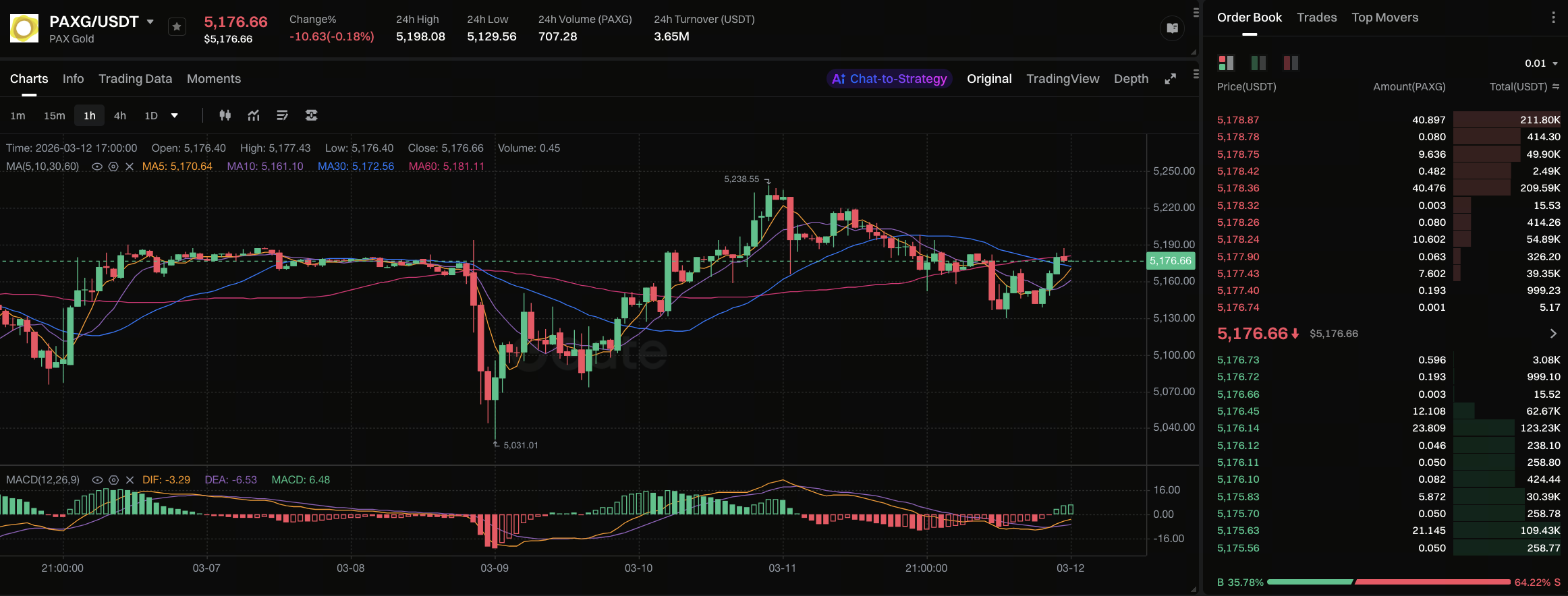
For example, 1 PAXG = 1 ounce of gold.
This structure offers several clear advantages:
- Transparent gold pricing
- Highly standardized assets
- Mature custody systems
Thus, precious metals are among the easiest physical assets to tokenize.
RWA Assets That May Emerge in the Future
As blockchain technology and regulatory frameworks mature, more types of RWA assets may appear in the future. For example:
Tokenized Stocks
Stocks can be digitally represented on blockchain. Potential advantages include:
- Global 24/7 trading
- Lower transaction costs
- Higher asset composability
Many industry observers believe tokenized stocks may become a major future direction for RWAs.
Infrastructure Assets
Some long-term stable-yield assets are well-suited for tokenization, such as:
- Data centers
- Power projects
- Toll road systems
- Renewable energy projects
These assets typically have:
- Long-term cash flows
- Stable yield structures
They are highly suitable as long-term investment RWAs.
Intellectual Property
More intangible assets may be tokenized in the future, such as:
- Music copyrights
- Film revenue rights
- Game revenue sharing
If these assets can be legally clarified and structured, they could become new RWA types.
Why Are Treasuries Leading the First Wave of RWAs?
Looking at the overall market trajectory, Treasuries dominate the first phase of RWA development. Treasuries combine low risk, stable returns, and transparent pricing—making them ideal as the first real-world assets integrated into blockchain systems. DeFi has long lacked stable yield sources; Treasuries provide relatively steady rate returns and are more easily accepted by the market. Many institutions see Treasury RWAs as the first bridge connecting traditional finance (TradFi) with DeFi: they provide stable yield to blockchain while offering traditional financial institutions a relatively safe entry point into the on-chain world.
Case Study: How Trading Platforms Connect TradFi and RWA: Gate TradFi
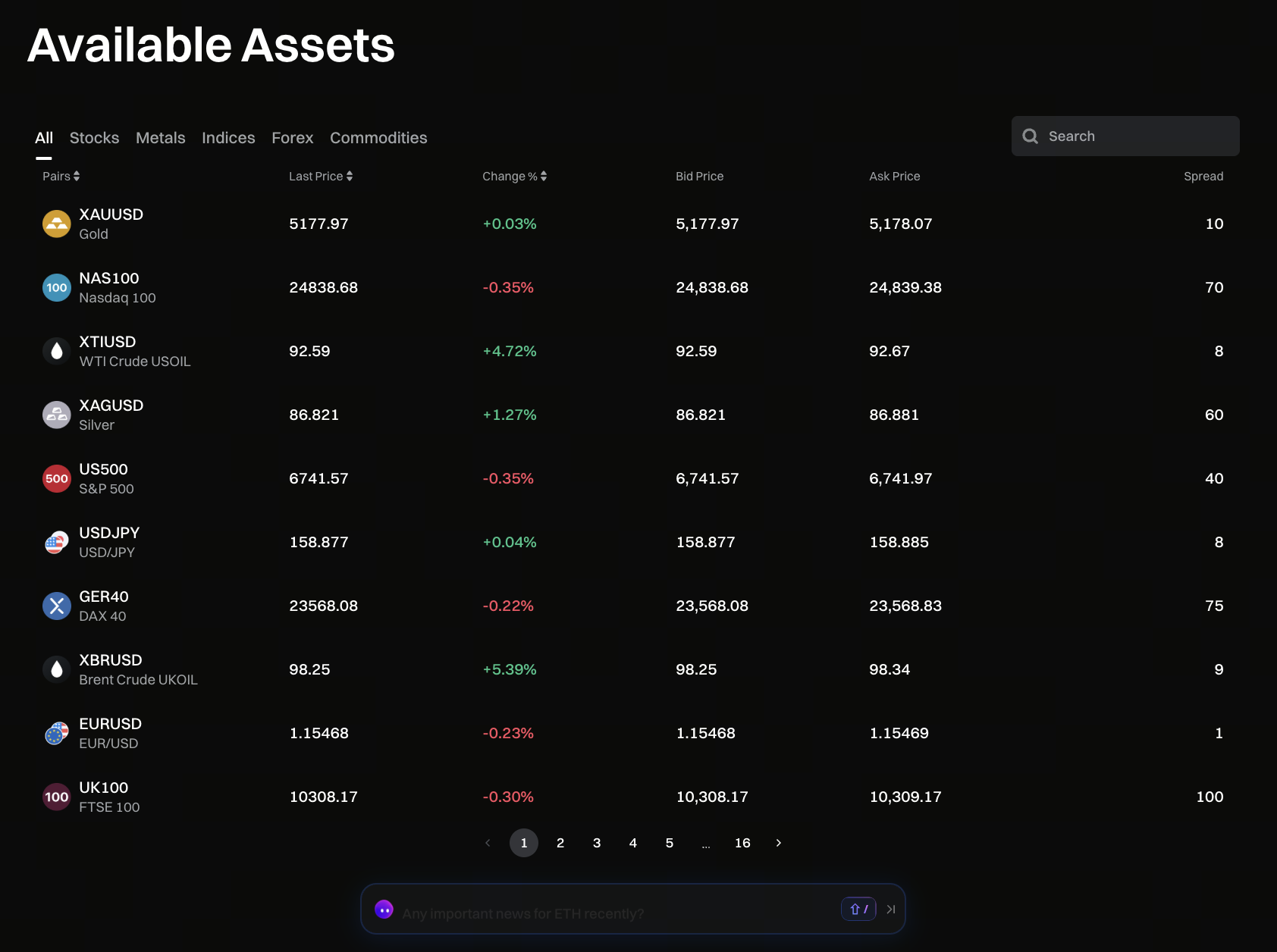
Image Source: Gate TradFi Page
In real markets, RWAs are not just concepts—they require trading platforms and financial infrastructure to link real-world assets with the on-chain financial ecosystem. Gate TradFi is an example: some crypto trading platforms have begun establishing dedicated TradFi asset sections to offer users new ways to access real-world assets.
Within Gate’s TradFi system, the platform attempts to integrate traditional financial assets with blockchain trading environments by:
- Providing entry points for precious metal asset trading (e.g., gold)
- Establishing traditional asset price data and trading systems
- Offering users digital channels to access traditional financial assets
The core significance of this model is that trading platforms become important gateways for real-world assets entering the crypto market.
In traditional finance, investors typically purchase assets through banks, brokerages, or fund platforms; in crypto ecosystems, trading platforms can serve similar roles by integrating different asset types into a unified digital financial market.
Structurally, these platforms are generally positioned between the “application layer” and “market layer”: real-world assets → legal structuring → asset tokenization → trading platform / DeFi market.
Once assets are tokenized, trading platforms can provide:
- Trading liquidity
- Market price discovery
- Investor access
In other words, platforms are not just marketplaces—they are increasingly becoming key financial infrastructure connecting TradFi and DeFi.
As more real-world assets are tokenized, platforms like Gate TradFi may become vital entry points for users to access RWAs and further accelerate the integration of real-world assets into blockchain finance.
Summary
The current RWA market is mainly concentrated in several core asset categories:
- Treasuries—renowned for stable returns and low risk—are currently the fastest-growing RWA type.
- Private Credit—these assets typically offer higher yields but also come with greater credit risk.
- Real Estate is frequently discussed due to its massive market size but progresses slowly because of complex legal and management structures.
- Precious metals (such as gold) are highly standardized and have transparent pricing, making them easier to tokenize.
Among these assets, Treasury RWAs are developing most rapidly. They not only provide DeFi with stable yield sources but also serve as important entry points for traditional financial institutions moving into blockchain ecosystems.
Lesson 1:What is RWA? Understanding the Basic Concept of Real World Assets On-Chain
Lesson 2:How Does RWA Work? The Complete Process of Bringing Real-World Assets On-Chain
Lesson 3:The Core Structure of RWA: How Are Real-World Assets Tokenized?
Lesson 4:Main Types of RWA Assets: Which Real-World Assets Are Entering the Blockchain?
Lesson 5:Why Has RWA Suddenly Exploded? The Three Driving Forces
Related Courses
The Beginner's Guide to Blockchain-based Airdrops
Crypto Mining Equipment

Learn about web3 data and analytics

Identity in Crypto: Main Projects
Introduction to Masternode Tokens