Trade
Basic
Futures
Futures
Hundreds of contracts settled in USDT or BTC
TradFi
Gold
One platform for global traditional assets
Options
HOT
Trade European-style vanilla options
Unified Account
Maximize your capital efficiency
Demo Trading
Futures Kickoff
Get prepared for your futures trading
Futures Events
Participate in events to win generous rewards
Demo Trading
Use virtual funds to experience risk-free trading
Earn
Launch
CandyDrop
Collect candies to earn airdrops
Launchpool
Quick staking, earn potential new tokens
HODLer Airdrop
Hold GT and get massive airdrops for free
Launchpad
Be early to the next big token project
Alpha Points
New
Trade on-chain assets and enjoy airdrop rewards!
Futures Points
New
Earn futures points and claim airdrop rewards
Investment
Simple Earn
Earn interests with idle tokens
Auto-Invest
Auto-invest on a regular basis
Dual Investment
Buy low and sell high to take profits from price fluctuations
Soft Staking
Earn rewards with flexible staking
Crypto Loan
0 Fees
Pledge one crypto to borrow another
Lending Center
One-stop lending hub
VIP Wealth Hub
Customized wealth management empowers your assets growth
Private Wealth Management
Customized asset management to grow your digital assets
Quant Fund
Top asset management team helps you profit without hassle
Staking
Stake cryptos to earn in PoS products
Smart Leverage
New
No forced liquidation before maturity, worry-free leveraged gains
GUSD Minting
Use USDT/USDC to mint GUSD for treasury-level yields

More

Featured Courses
More
Advanced
Tools That Help You Trade Better: Moving Averages, Trend Lines, and Indicators
There are no trading rules that are applicable to any scenario. These courses will help you establish your own trading strategy, then test it and improve on it in practice

Intermediate
Technical Analysis: A Useful Tool to Understand Trends in Futures Trading
Learn to interpret candlestick patterns and identify market trends. Build a technical analysis system to make informed trading decisions.

Intermediate
Identity in Crypto: Main Projects
Welcome to the comprehensive course on "Identity in Crypto: Main Projects." In this cutting-edge course, we will embark on a journey to explore the fascinating realm of Identity Tokens within the cryptocurrency ecosystem. As the world embraces blockchain technology and decentralized applications, the importance of secure and verifiable identity solutions becomes paramount. This course will give you in-depth knowledge of Identity Tokens, their significance in the Web3 ecosystem, and their potential to revolutionize identity verification, privacy, and trust. Join us on this enlightening exploration, and equip yourself with the expertise to navigate the dynamic landscape of decentralized identity in the digital age.
Learn by Topic
Topics
Altcoins
Bitcoin
Blockchain
DeFi
Ethereum
Metaverse
NFT
Trading
Tutorial
Futures
Quant Trading
BRC-20
GameFi
DAO
Macro Trends
Wallets
Inscription
Technology
Meme
AI
SocialFi
DePin
StableCoin
Liquid Staking
Finance
RWA
Modular Blockchains
Zero-Knowledge Proof
Restaking
Crypto Tools
Airdrop
Gate Products
Security
Project Analysis
CryptoPulse
Research
TON Ecosystem
Layer 2
Solana
Payments
Mining
Hot Topics
P2P
Sui Ecosystem
Chain Abstraction
Options
Quick Reads
Video
Daily Report
Market Forecast
Trading Bots
VIP Weekly Industry Report
ETF
Top Stories
XRP
Pi Network
VIP Daily Industry Report
In-Depth Research
Gate Ventures
Weekly Report
Investment News
Perpetual DEX
Web3 For Beginners
Base
Protocols
DApp
Crypto Card
BNB Chain
Gate Private Wealth Management
Platform Highlights
Brand Videos
Product Tutorial Videos
The Latest News
TradFi
Difficulty
Beginner
Intermediate
Advanced
Latest Courses
More
Intermediate
Oracle Mechanisms Explained: Why On-Chain Finance Depends on Off-Chain Data
Blockchain is regarded as a technological foundation capable of providing trusted computing and decentralized collaboration, ensuring the security and verifiability of on-chain data through consensus mechanisms and cryptographic structures. However, this highly secure design also brings a significant limitation: the blockchain itself is a closed system that cannot directly access real-world information. As more financial and commercial applications begin to operate on-chain, the importance of external data has become increasingly prominent. Whether it is asset prices, macroeconomic indicators, or real-world events, this information has become a critical condition for the proper functioning of smart contracts. How to introduce off-chain data onto the chain while ensuring security and trustworthiness has become a core issue that the Web3 ecosystem must solve, and oracles are the key infrastructure born out of this context.

Intermediate
RWA Beginner’s Guide: How Real-World Assets Enter the Blockchain World
Real World Assets (RWA) are becoming an important bridge connecting Traditional Finance (TradFi) and blockchain finance. Through asset tokenization, real-world assets such as government bonds, real estate, credit, and precious metals can be introduced into blockchain networks, achieving higher liquidity, lower entry barriers, and a more transparent trading environment.

Intermediate
From Stablecoins to On-Chain Finance: Building the Infrastructure of a New Financial Era
Stablecoins have evolved from settlement tools for crypto transactions into the core infrastructure of the on-chain financial system. Whether it's trading, lending, or cross-chain liquidity, most on-chain financial activities revolve around stablecoins. In a sense, they constitute the "monetary layer" of the blockchain world. This course begins with stablecoins to systematically outline the logic behind the formation of on-chain finance: from the credit structure of stablecoins, to liquidity networks, and then to the DeFi credit market. It also compares these with the institutional differences in traditional finance, helping readers understand how on-chain finance is gradually forming a new infrastructure structure.
Latest Articles
More
Beginner
What Is ether.fi? A Non-Custodial Liquid Staking Protocol for Ethereum
ether.fi is a non-custodial liquid staking and restaking protocol built on Ethereum that enables users to stake ETH while retaining control over their assets and receiving liquid staking tokens such as eETH. With the expansion of Ethereum staking and decentralized finance, it has become part of a broader infrastructure that combines staking, liquidity, and extended security mechanisms.
2026-03-20 11:20:02

Beginner
How Do the Working Mechanisms of ether.fi Operate?
ether.fi is a non-custodial liquid staking and restaking protocol that integrates validator infrastructure, tokenized liquidity, and automated reward distribution. It allows users to stake ETH, receive liquid tokens such as eETH, and participate in both staking and restaking without locking capital. Its working mechanisms illustrate how Ethereum staking is evolving toward more flexible and composable financial systems.
2026-03-20 11:14:54

Beginner
What Is Bonk (BONK)? Solana Meme Coin Rise, Tokenomics, and Ecosystem Role
Bonk (BONK) is a community driven meme coin built on the Solana blockchain. Since its launch, it has gained rapid attention through large scale airdrops, strong community culture, and deep ecosystem integration. As one of the key entry points for user activity within the Solana ecosystem, BONK represents the continuation of the meme coin narrative while also contributing to user growth and application activation across the network.
2026-03-20 11:08:56
Latest Research
More
Advanced
 Gate Research: AIA Surges Over 33% in 24 Hours | Structural Pullback Continues Across Crypto Market
Gate Research Daily Report: On March 20, BTC held above $70,000 after a pullback, ETH stabilized near $2,100, and GT rebounded to $6.86 from recent lows. The broader market remained in a structural correction, while AIA led gains with a 33.07% surge. Meanwhile, the crypto market structure bill continued to advance, BTC showed relative resilience amid macro volatility, and SEC Chair Paul Atkins said the latest crypto legal interpretation is only the beginning.
2026-03-20 08:31:38
Advanced
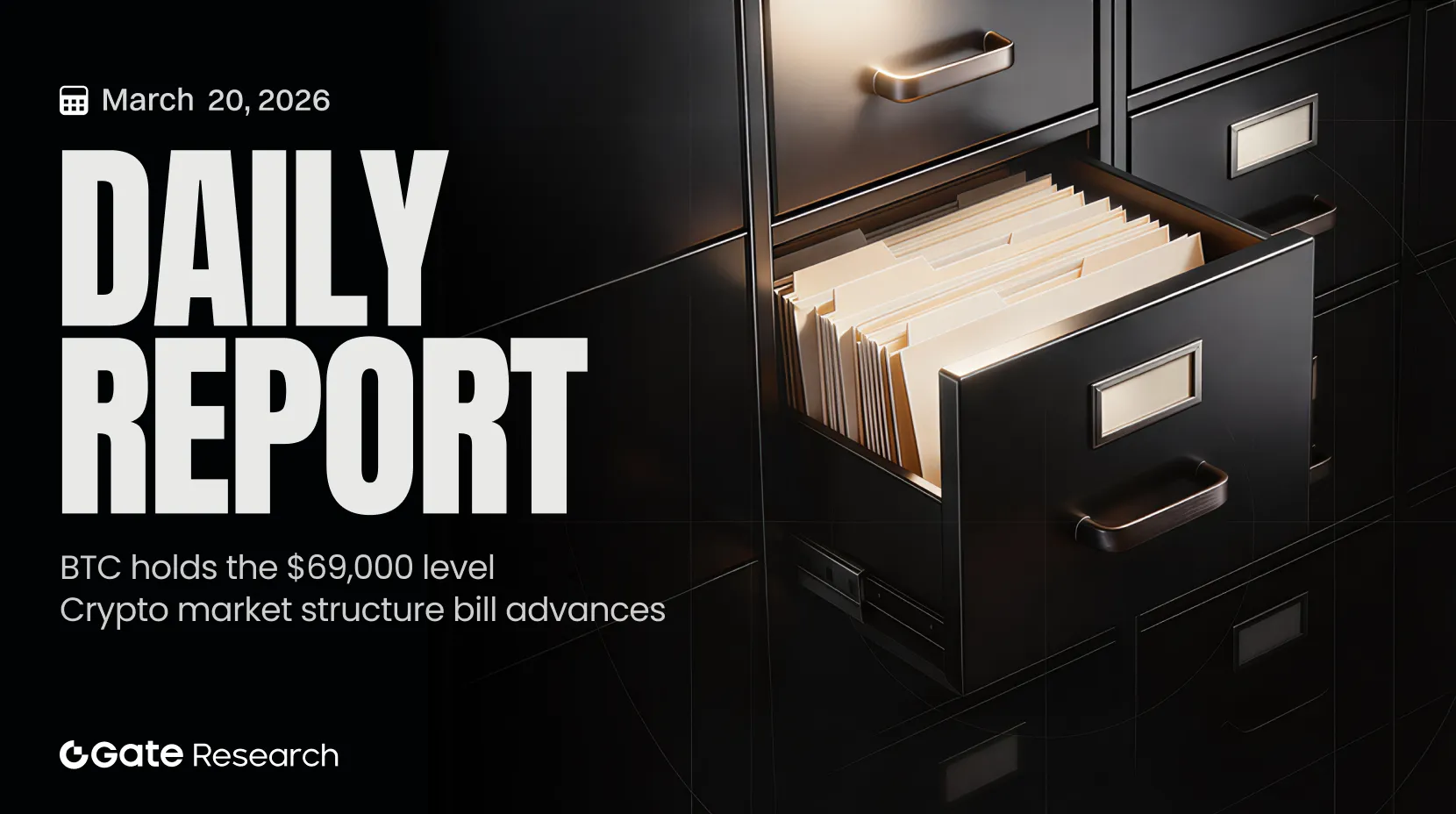
Gate Research: BTC Holds the $69,000 Level | Crypto Market Structure Bill Advances
Gate Research Daily Report: On March 20, BTC held above $70,000 after a pullback, ETH stabilized near $2,100, and GT rebounded to $6.86 from recent lows. The broader market remained in a structural correction, while AIA led gains with a 33.07% surge. Meanwhile, the crypto market structure bill continued to advance, BTC showed relative resilience amid macro volatility, and SEC Chair Paul Atkins said the latest crypto legal interpretation is only the beginning.
2026-03-20 08:10:19

Advanced
Gate Research: February 2026 Crypto Market Review
In February, the overall crypto market showed a weak trend, with notable outflows from BTC ETFs. Major blockchains remained stable throughout the month, with Solana leading by a wide margin at over 100 million daily transactions. Ethereum recorded 13.34 million unique active addresses, maintaining its second-highest level in history. TradFi trading volume on Perp DEXs surged to $47.3 billion, largely driven by Hyperliquid’s HIP-3. The Web3 sector completed 46 funding rounds totaling $986 million, with the top 10 projects accounting for $793 million—three major deals were led by Tether. Meanwhile, Web3 security incidents declined significantly month-over-month, though smart contract vulnerabilities remained the primary risk source.
2026-03-20 07:14:50
Glossary
Moreapr
Annual Percentage Rate (APR) represents the yearly yield or cost as a simple interest rate, excluding the effects of compounding interest. You will commonly see the APR label on exchange savings products, DeFi lending platforms, and staking pages. Understanding APR helps you estimate returns based on the number of days held, compare different products, and determine whether compound interest or lock-up rules apply.
fomo
Fear of Missing Out (FOMO) refers to the psychological phenomenon where individuals, upon witnessing others profit or seeing a sudden surge in market trends, become anxious about being left behind and rush to participate. This behavior is common in crypto trading, Initial Exchange Offerings (IEOs), NFT minting, and airdrop claims. FOMO can drive up trading volume and market volatility, while also amplifying the risk of losses. Understanding and managing FOMO is essential for beginners to avoid impulsive buying during price surges and panic selling during downturns.
nft
An NFT (Non-Fungible Token) is a unique certificate recorded on the blockchain that represents ownership and attributes of a specific digital work or on-chain asset. NFTs are minted by smart contracts, which also store their metadata. Unlike fungible tokens, NFTs are indivisible and cannot be exchanged on a one-to-one basis. They are commonly used in digital art, in-game items, event tickets, and membership passes, enabling proof of ownership, provenance tracking, and trading. Some platforms also support creator royalties and cross-chain display of NFTs.
leverage
Leverage refers to the practice of using a small amount of personal capital as margin to amplify your available trading or investment funds. This allows you to take larger positions with limited initial capital. In the crypto market, leverage is commonly seen in perpetual contracts, leveraged tokens, and DeFi collateralized lending. It can enhance capital efficiency and improve hedging strategies, but also introduces risks such as forced liquidation, funding rates, and increased price volatility. Proper risk management and stop-loss mechanisms are essential when using leverage.


Your Gateway to Crypto World, Subscribe to Gate for a New Perspective