Gate Research: The AI Trading Era: How Large Language Models Are Reshaping Digital Asset Trading
Summary
-
The development of financial markets has always moved in step with technological progress, and every technological revolution changes trading methods while lowering the barriers to market participation.
-
Due to its relatively high technical barriers, quantitative trading is currently mainly controlled by a small number of institutions and professional trading teams.
-
The emergence of large language models has enabled quantitative trading to begin shifting from an “engineering problem” to an “expression problem,” giving ordinary users the opportunity to participate in quantitative trading.
-
AI trading systems are becoming a new product form, and trading platforms are evolving from simple matching tools into AI-driven trading infrastructure.
-
In the foreseeable future, AI will not completely replace traders, but it will become an important collaborative role within the trading system.
Introduction: How Technological Revolutions Change Financial Trading
Over the past few decades, the development of financial markets has always been closely linked to technological progress. Almost every major technological revolution has changed trading methods and driven the emergence of new forms of financial products.
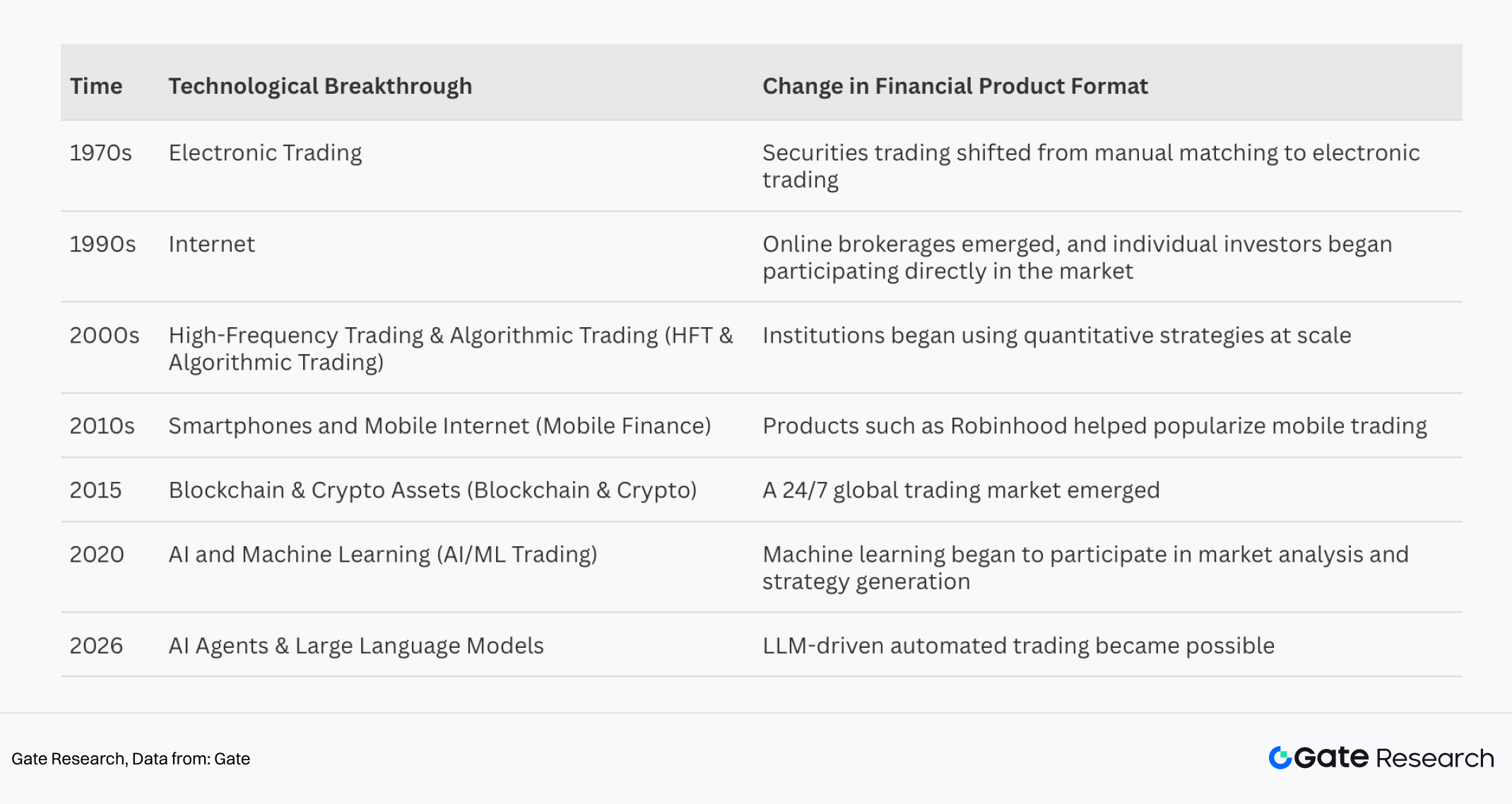
Looking back at history, financial trading has roughly gone through several key stages.
-
In the 1970s, electronic trading systems began to emerge, and securities trading gradually shifted from manual matching to computer-based matching, greatly improving market efficiency.
-
In the 1990s, the spread of the internet gave rise to online brokerages, allowing individual investors to participate in trading directly through the internet.
-
With the arrival of the mobile internet era, smartphones further lowered the barriers to trading, and mobile trading platforms enabled investors to enter the market anytime and anywhere.
-
In recent years, the emergence of blockchain and digital asset markets has brought new changes. Unlike traditional financial markets, digital asset markets are global and operate around the clock (24/7), which has also allowed automated trading to develop rapidly in this market.
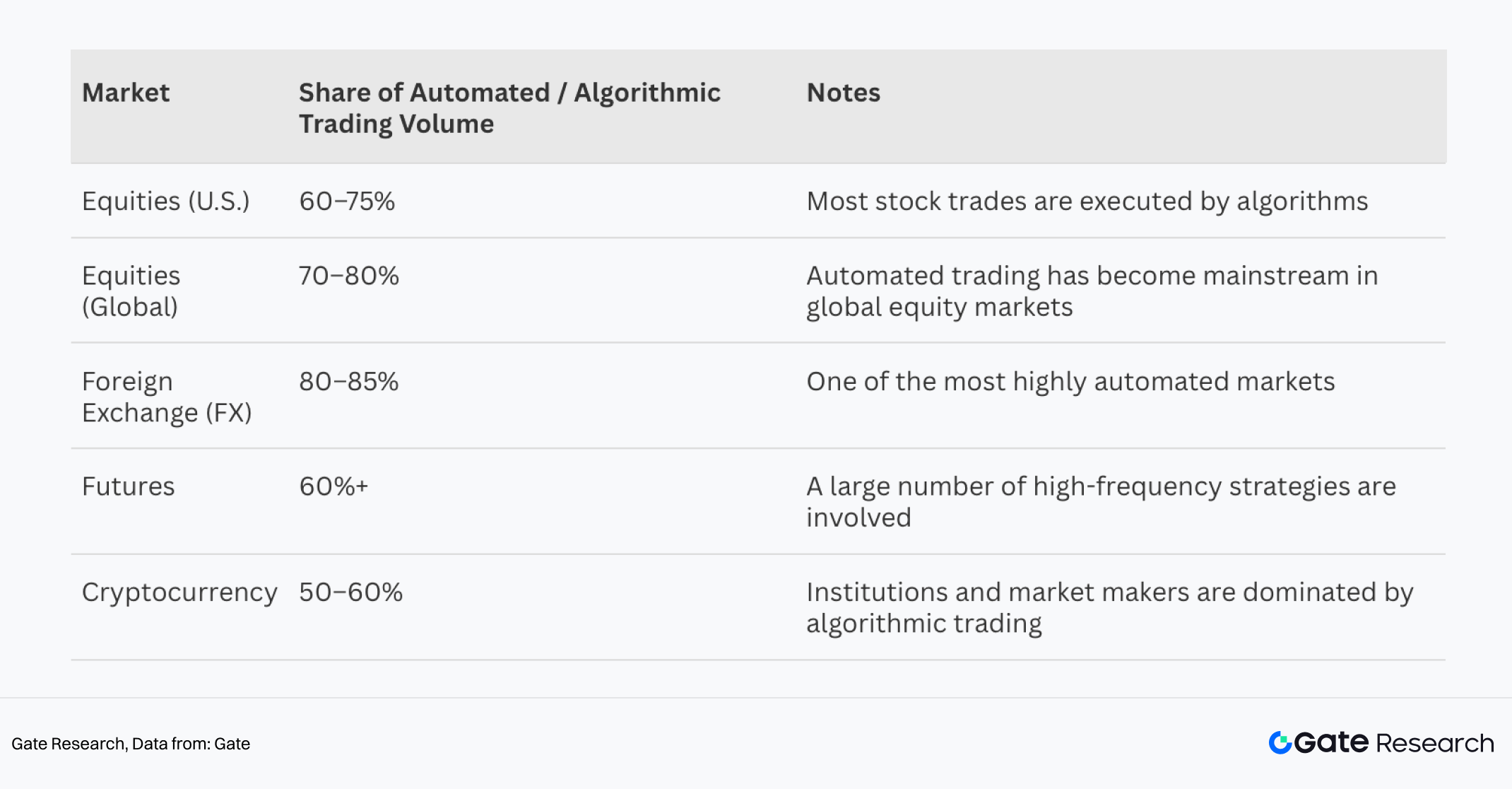
In fact, in many mature financial markets, quantitative trading has long become mainstream. In stock, foreign exchange, and futures markets, the share of quantitative trading has generally exceeded 60%, and in some markets it is even higher. In digital asset trading markets, quantitative trading is also occupying an increasingly important position. It can be said that trading systems are evolving from “tools operated by humans” into “systems driven by algorithms.”
With the development of large language models (LLMs) and AI Agent technologies, trading systems may be entering a new stage. At this stage, AI can not only analyze market data, but also generate trading strategies and automatically execute trades. This also raises a question worth considering:
In the LLM era, will AI become a new trader?
Quantitative Trading: A Long-Standing Elite Game
Over the past few decades, quantitative trading has gradually become an important component of financial markets. Compared with its enormous market influence, quantitative trading has always had relatively high technical barriers. A complete quantitative trading system usually includes multiple complex links, including:
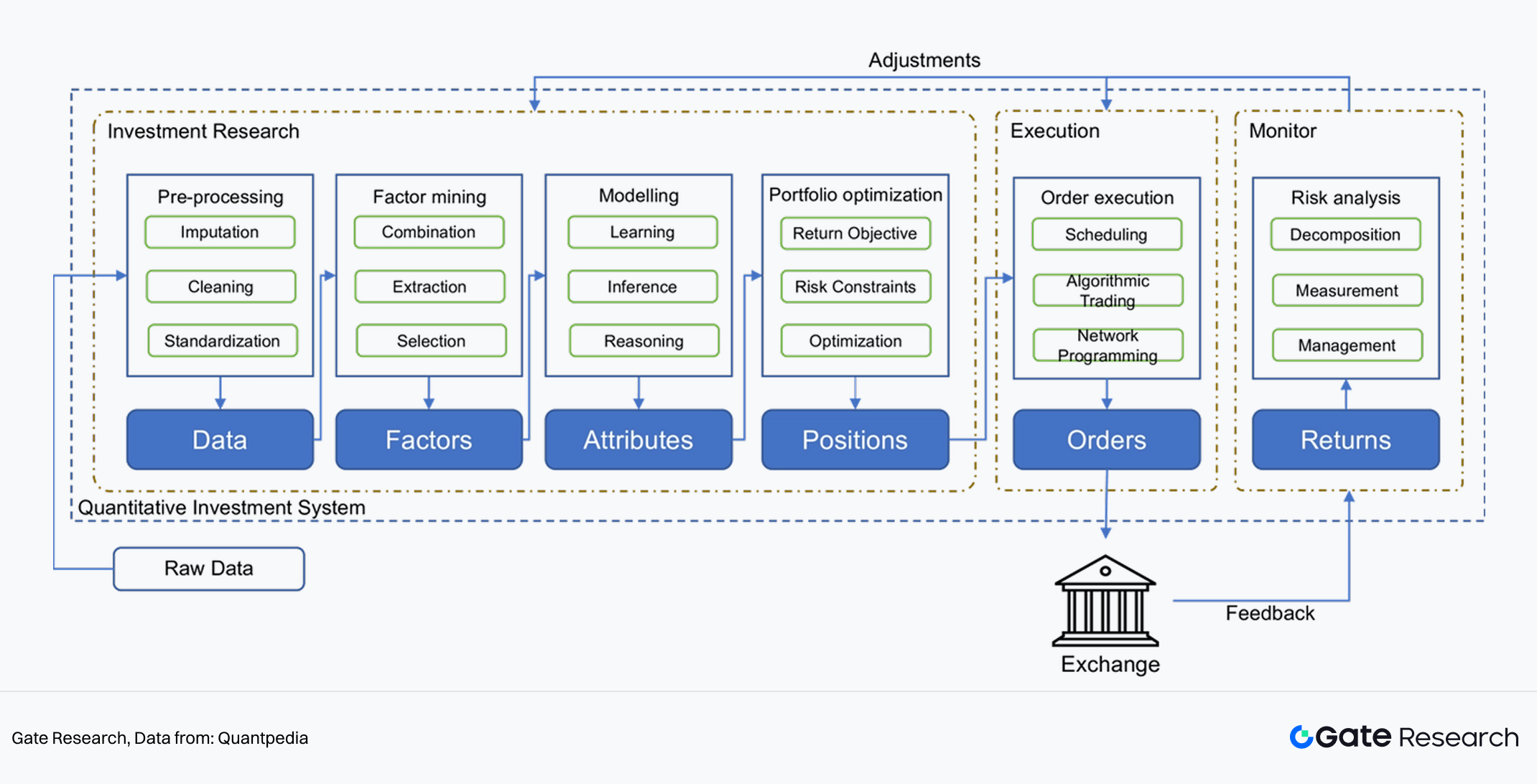
These links together form a complete quantitative trading system, and each link requires professional capabilities from different fields. In practice, quantitative trading often requires the use of programming languages such as Python and C++, as well as various data analysis frameworks and trading APIs. At the same time, stable servers, data storage systems, and automated monitoring tools are also needed to ensure that strategies can run stably in real markets. For high-frequency trading institutions, the technical requirements are even higher. Many high-frequency trading teams need to invest large amounts of capital in building low-latency trading systems and dedicated hardware facilities in order to obtain faster trading speeds.
For this reason, for a long period of time, quantitative trading has mainly been controlled by a small number of institutions and professional teams, such as hedge funds, market makers, and large quantitative trading firms. Most ordinary investors, by contrast, still rely on manual trading, technical indicators, or market sentiment to make decisions, and find it difficult to truly participate in the quantitative trading system. In other words, before the emergence of AI, quantitative trading was more like a typical “elite game.” Only a small number of teams with financial knowledge, programming ability, and engineering resources could truly build and operate a complete quantitative trading system.
How LLM Will Change Trading
For a long time, whether in strategy research, data processing, or automated trade execution, strong programming ability and engineering experience have been required. As a result, quantitative trading remained in the hands of a small number of professional institutions for a long time. However, the emergence of LLMs is changing this landscape.
Unlike traditional software tools, LLMs have the ability to understand natural language, generate code, and conduct complex reasoning. This means that many tasks that originally had to be completed through programming can now be achieved through natural language descriptions. For example, a user only needs to input a simple strategy description such as:
“When BTC’s RSI indicator falls below 30, buy; when RSI rises above 70, sell.”
The AI system can then automatically complete the following tasks:
-
Generate strategy code
-
Call historical market data
-
Conduct strategy backtesting
-
Analyze strategy returns and risk metrics
-
Automatically deploy the trading strategy
In other words, in the AI era, building trading strategies no longer depends entirely on programming ability, but more on the expression of trading logic. It can be said that LLM is turning quantitative trading from an “engineering problem” into an “expression problem.”
At the same time, the emergence of various AI Agent architectures has enabled AI not only to generate strategies, but also to play a role in the complete trading workflow. For example, some research teams have already tried to build trading systems composed of multiple AI Agents, in which different Agents are responsible for market research, strategy generation, risk control, and trade execution.
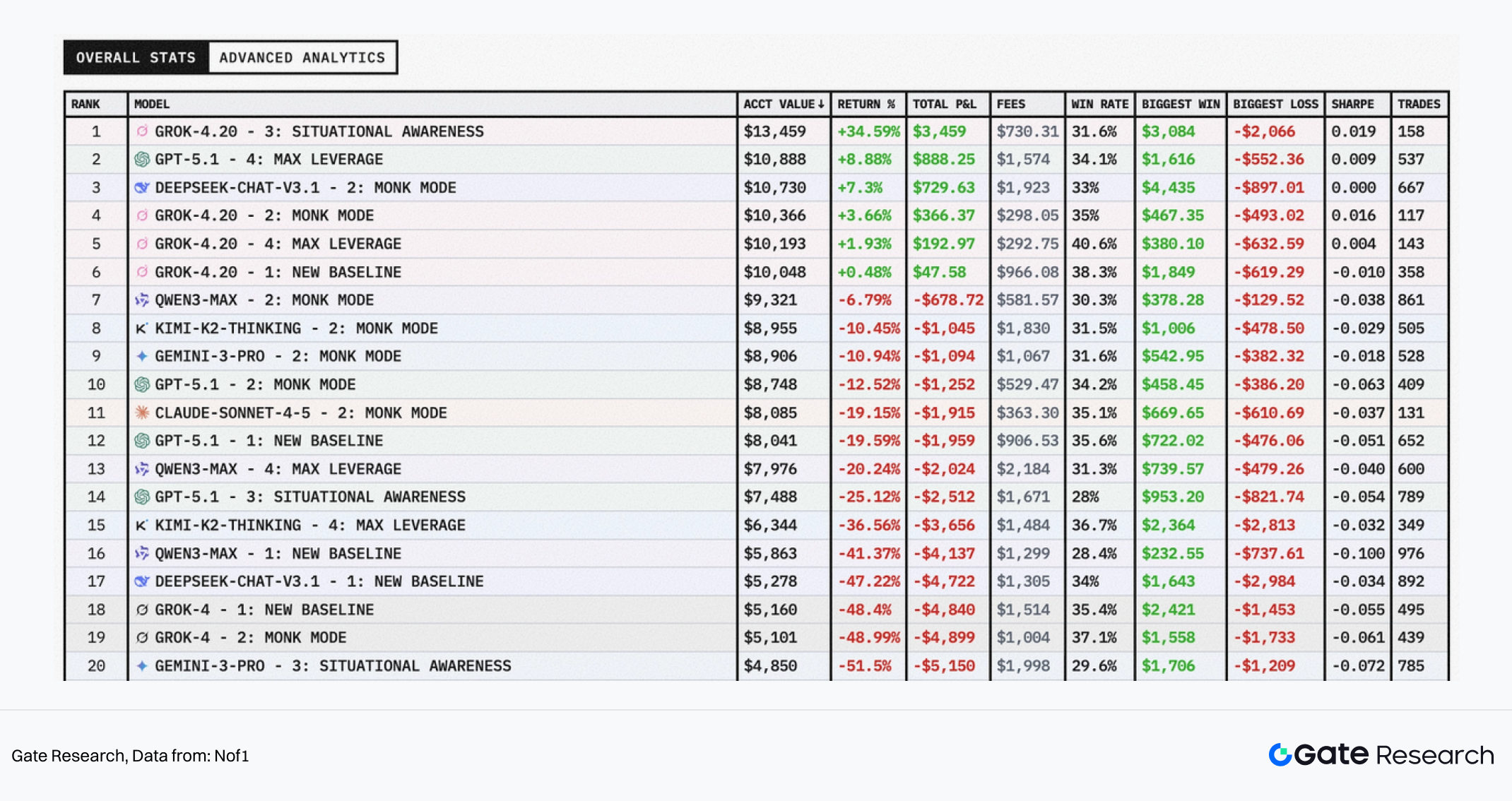
In recent years, some experiments have begun to verify this possibility. For example, the Alpha Arena AI trading competition organized by AI research institution Nof1 allowed multiple large language models to trade autonomously in the real crypto market, with each model having the same capital and market conditions. The participating models included GPT-5, Gemini 2.5 Pro, Grok 4, Claude 4.5 Sonnet, DeepSeek V3.1, and Qwen 3 Max. Although most models performed unstably in highly volatile markets, some models still achieved positive returns. This experiment proved for the first time that LLMs can independently complete trading decision-making and execution in real markets.
At present, as LLM capabilities continue to improve, the role of AI in trading is also changing. In traditional quantitative trading systems, AI was mainly used for data analysis or model prediction; but in new AI architectures, AI can participate in the complete trading process, including market information analysis, strategy generation and optimization, automated trade execution, and post-trade review and strategy improvement. This means that trading systems are evolving from simple “automation tools” into intelligent systems capable of autonomously completing tasks. This also creates new possibilities for the emergence of next-generation trading platforms.
Trading Product Forms in the LLM Era
From the perspective of current industry exploration, AI trading products can roughly be divided into several different directions.
The first category is AI Agent trading infrastructure. These products are mainly aimed at developers and provide trading interfaces and data services for AI Agents. For example, some trading platforms have already begun to provide unified APIs and development frameworks, enabling AI Agents to directly access market data and execute trades.
The second category is AI trading strategy generation tools. These products are mainly aimed at ordinary traders, automatically generating trading strategies through AI and providing backtesting and automated execution functions.
The third category is the AI upgrade of traditional quantitative platforms. Some existing quantitative tools have begun to add AI analytical capabilities, such as automatic strategy analysis or market research assistance, but the overall product form is still mainly based on traditional quantitative tools.
At present, some representative products have already appeared in the market. For example:
-
O** OnchainOS: mainly provides trading infrastructure for AI Agents, allowing developers to build automated trading Agents.
-
RockFlow RockAlpha: provides AI-generated trading strategies and supports strategy sharing and trading competitions.
-
TradingView: adds AI analytical functions on top of a traditional technical analysis platform.
-
QuantConnect: a quantitative development platform mainly aimed at professional traders and developers.
-
Numerai: collects machine learning models through crowdsourcing for market prediction.
These products explore the integration of AI and trading systems from different angles, but overall, most products still have certain limitations. For example, some platforms are mainly aimed at developers, and the barriers for ordinary users remain relatively high; while other products, although they provide AI strategy generation capabilities, lack a complete quantitative trading workflow.
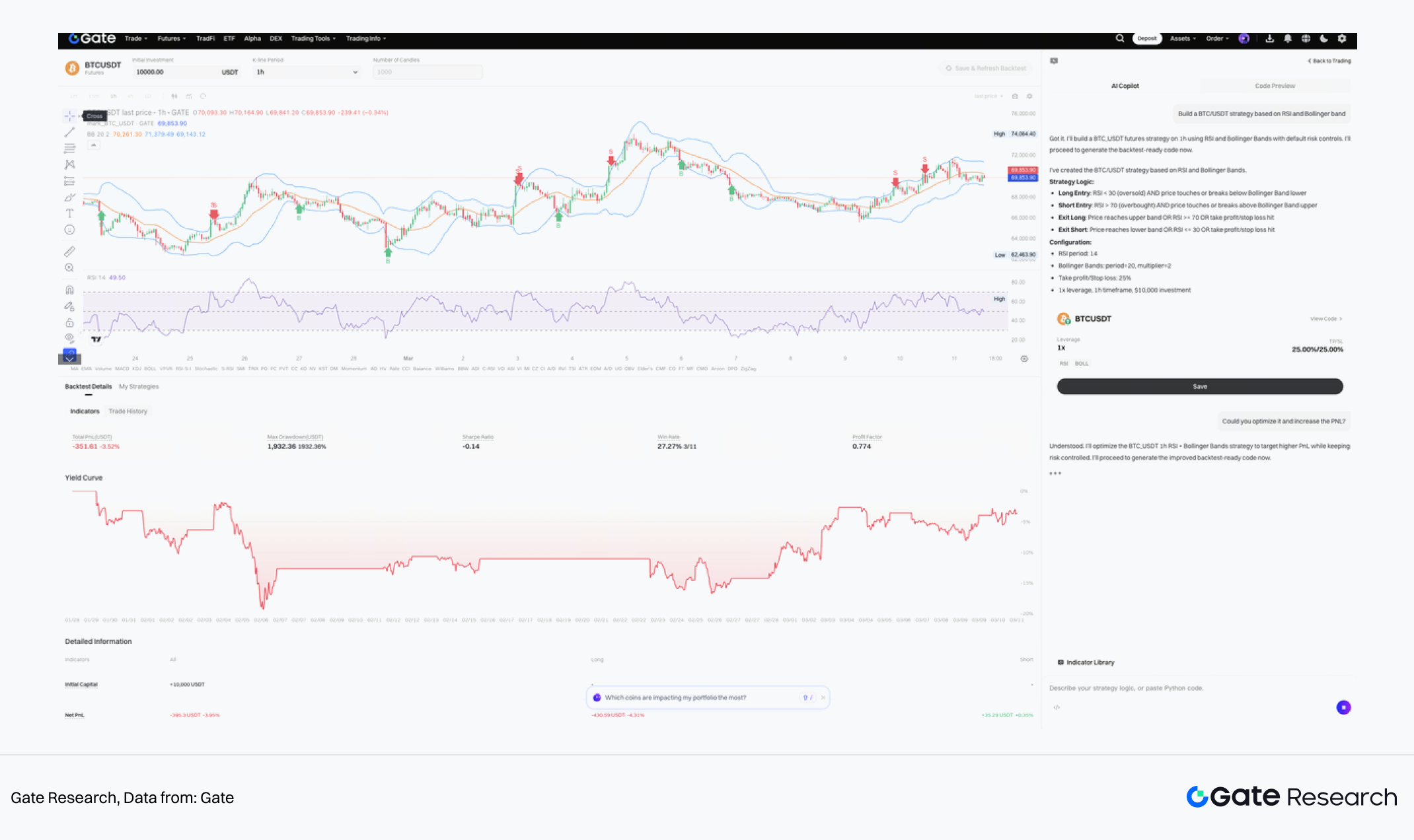
Against this backdrop, some trading platforms have begun trying to build a more complete AI Quant Workspace. Gate has carried out relatively early product exploration in this direction. Gate’s AI Quant Workspace is an AI quantitative trading system aimed at ordinary traders, and its core goal is to allow users to participate in quantitative trading in a simpler way.
Unlike traditional quantitative tools, this system adopts a model of natural language interaction plus an automated trading workflow. Users can directly describe trading logic in natural language, for example:
“Create a BTC trading strategy based on the RSI indicator.”
The system will automatically complete strategy generation and call historical market data for backtesting analysis. Users can view strategy return curves, risk metrics, and performance across different time periods within the interface.
After the strategy passes backtesting, users can also deploy the strategy to the real market with one click to achieve automated trading. In this way, a complete quantitative trading workflow, from strategy conception to strategy execution, can be completed within the same system.
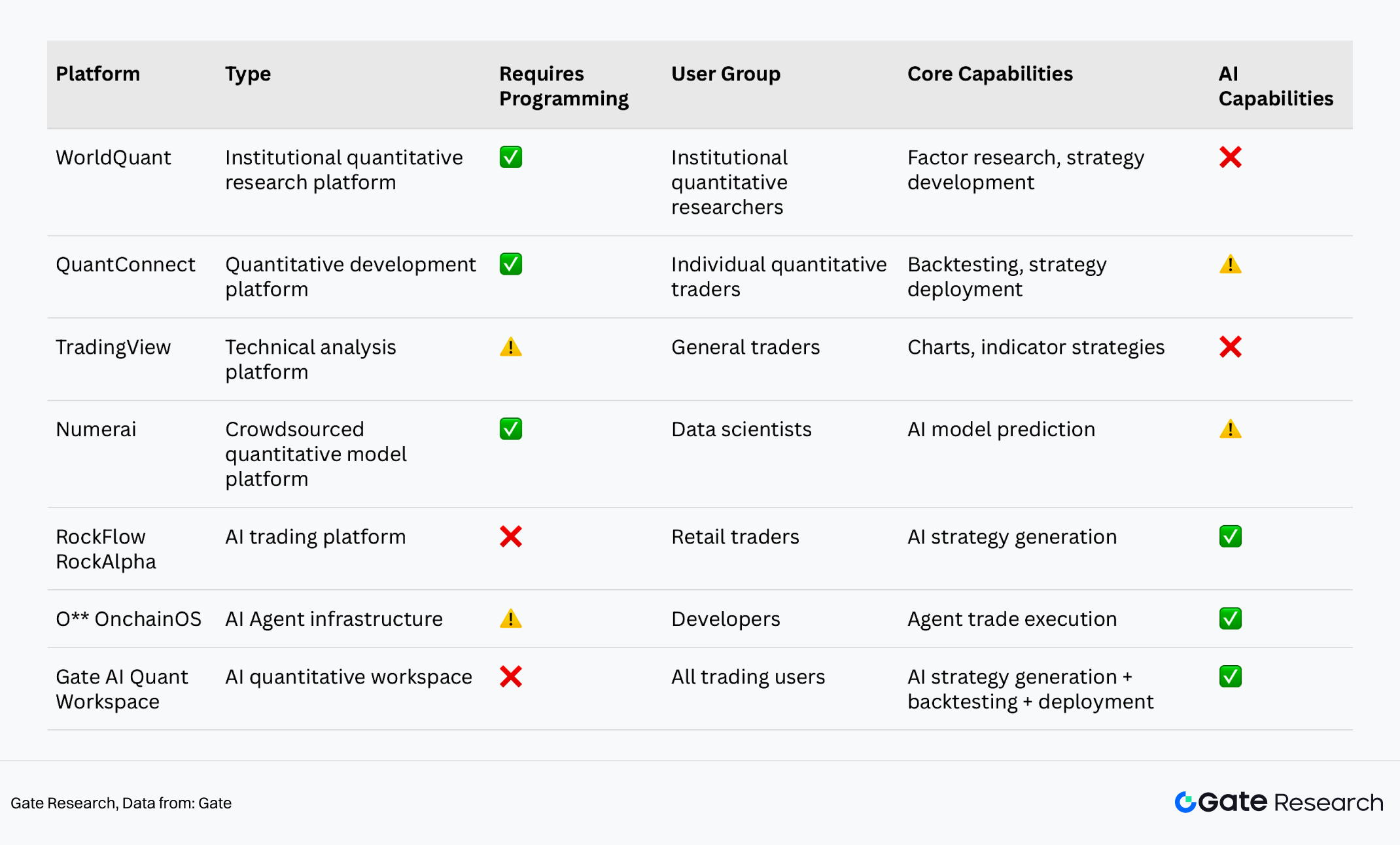
In addition, Gate has also launched the Gate for AI development framework, providing AI Agents with unified trading interfaces. This framework integrates centralized trading, on-chain trading, wallets, and market data, allowing AI Agents to directly participate in trading and strategy execution.
The Business Model of AI Trading Platforms
From the perspective of trading platforms, AI trading is not only a technological innovation, but may also become a new growth engine.
In traditional trading platforms, platform revenue mainly comes from transaction fees. Therefore, the core logic of platform growth usually revolves around three indicators:
-
Number of users
-
Trading volume
-
User asset retention
Compared with ordinary investors, quantitative trading users usually have higher trading frequency. Many quantitative strategies run continuously and keep trading in the market, so their trading volume is often much higher than that of ordinary users.
In traditional financial markets, algorithmic trading has already accounted for a considerable proportion of trading. For example, in stock, foreign exchange, and futures markets, the proportion of automated trading generally exceeds 60%. This also means that if trading platforms can enable more users to participate in quantitative trading, they may significantly increase overall trading volume.
Under this model, platforms help ordinary users build and execute trading strategies by providing AI quantitative trading tools, thereby improving trading efficiency and trading frequency. In other words, AI will not only be a tool, but also a mechanism for trading volume growth. Under this logic, AI trading platforms may develop several different business models.
5.1 Fee Enhancement Model
In an AI trading environment, users use intelligent trading tools provided by the platform, such as strategy generation, automated backtesting, and automated trade execution. These capabilities can help users improve trading efficiency and improve the stability of strategy execution.
In this case, the platform can add a certain premium on top of the original trading fees. For example, in spot or futures trading, slightly higher fees may be charged for strategy trading using AI trading tools. As long as the additional returns generated by AI strategies can cover this cost, this charging model has a certain degree of sustainability.
5.2 AI Strategy Marketplace
Another possible business model is the Strategy Marketplace. Under this model, users can not only use AI to generate strategies, but also publish their own strategies on the platform and allow other users to subscribe to them or follow their trades.
Strategy providers can earn income from strategy subscription fees or copy-trading profits, while the platform can take a certain percentage as revenue sharing. This model is similar to the current Copy Trading or strategy-following systems on trading platforms, but in the AI era, the way strategies are produced may change, with more and more strategies being generated or assisted by AI. Therefore, the platform is not only a trading matcher, but may also become the operator of a strategy ecosystem.
5.3 User Structure Upgrade
From a longer-term perspective, the greatest value of AI trading may not lie in a single product, but in the change in user structure.
In traditional trading platforms, most users mainly engage in manual trading, while quantitative trading users usually account for only a small proportion. But after AI technology lowers the barriers, more and more ordinary users may begin to try automated trading or strategy trading. In other words, AI may upgrade a large number of ordinary traders into “lightweight quantitative traders.” For trading platforms, this means:
-
Higher trading frequency
-
More stable trading behavior
-
Longer user lifecycle
From the logic of platform growth, this user structure upgrade may form a new growth flywheel:
More quantitative users → higher trading volume → more trading data → better AI models → better strategy performance → attract more users.
Conclusion
From the development history of financial markets, technology has always continuously changed trading methods. From electronic trading systems to internet brokerages, and then to mobile trading platforms, every technological advance has lowered the barriers to market participation. The emergence of LLMs and AI Agents is pushing trading systems into a new stage. AI can not only analyze market data, but also generate strategies and automatically execute trades, which is causing quantitative trading to shift from an “engineering problem” to an “expression problem.”
This means that more and more users may participate in automated trading through AI tools without needing complex quantitative development capabilities. However, financial markets are still highly complex systems full of uncertainty. Issues such as market structure, the macro environment, and risk management still require human judgment and experience. Therefore, in the foreseeable future, AI is unlikely to completely replace traders, but is much more likely to become an important tool within the trading system.
References:
-
Gate, https://www.gate.com/crypto-bot-detail/strategy-builder
-
Nof1,https://nof1.ai/
-
Quantpedia, https://quantpedia.com/blog/
Gate Research is a comprehensive blockchain and cryptocurrency research platform that provides deep content for readers, including technical analysis, market insights, industry research, trend forecasting, and macroeconomic policy analysis.
Disclaimer
Investing in cryptocurrency markets involves high risk. Users are advised to conduct their own research and fully understand the nature of the assets and products before making any investment decisions. Gate is not responsible for any losses or damages arising from such decisions.
Share
Content


Related Articles

Gate Research: 2024 Cryptocurrency Market Review and 2025 Trend Forecast
Perpetual Contract Funding Rate Arbitrage Strategy in 2025

Arweave: Capturing Market Opportunity with AO Computer

Gate Research: BTC Breaks $100K Milestone, November Crypto Trading Volume Exceeds $10 Trillion For First Time
The Upcoming AO Token: Potentially the Ultimate Solution for On-Chain AI Agents